The rise of creator capital markets
We are watching a structural shift in how digital attention is valued. For years, the conversation around fan engagement centered on simple membership tiers or static merchandise. Today, that dynamic has evolved into what industry analysts are calling creator capital markets. This term describes an emerging financial system where content creators, influencers, and streamers can tokenize their social influence, turning their audience’s loyalty into tradable assets.
This is not merely a rebranding of fan tokens. The current wave involves complex financialized attention economies where tokens often function similarly to meme coins or utility-based securities. As noted by 21Shares, this "tokenized attention" model allows creators to pump value directly from their community into a liquid market, creating a feedback loop between content creation and financial speculation. The infrastructure supporting this is fragmented, spanning traditional finance, crypto-native platforms, and decentralized exchanges, but the trajectory is clear: attention is becoming a balance sheet asset.
The scale of this opportunity is anchored in the broader creator economy. According to recent market projections, the global creator economy is valued at approximately $254.4 billion in 2025 and is expected to surge to over $2 trillion by 2035. This massive expansion provides the liquidity and user base necessary for creator capital markets to mature. We are moving away from one-off transactions toward sustained, tokenized relationships between creators and their audiences.
While the technology is still maturing, the integration of automated market maker (AMM) tools by exchanges specifically for token issuers signals a institutionalization of this space. Creators are no longer just content producers; they are issuing assets. This convergence of media, community, and finance defines the new frontier of the digital economy.
The creator economy is scaling fast
The creator economy is no longer a niche sector; it is a major economic force. Global market size is calculated at $254.4 billion in 2025 and is projected to reach approximately $2,084.57 billion by 2035. This expansion represents a compound annual growth rate (CAGR) of 23.41% from 2026 to 2035, according to recent market analysis.
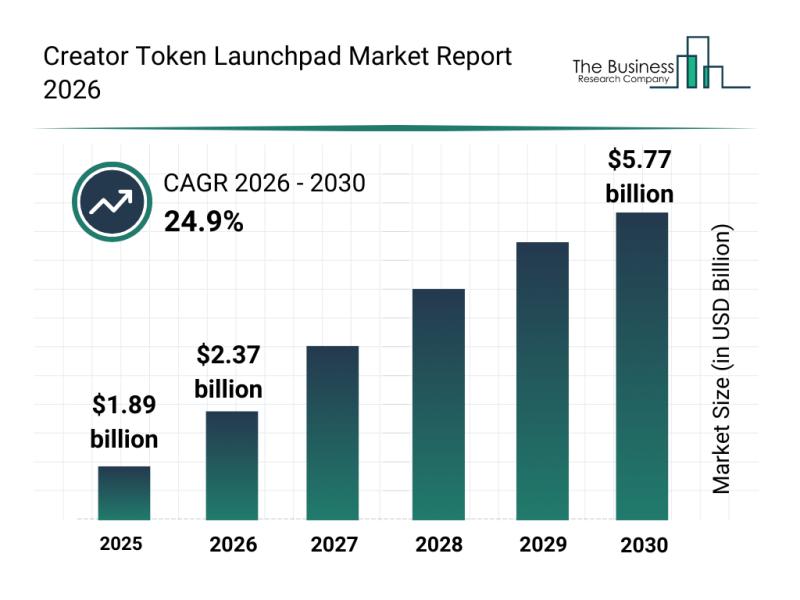
This rapid growth provides the infrastructure and audience base necessary for creator tokens to gain traction. As creators build larger, more engaged communities, the demand for direct monetization tools increases. The creator token launchpad market itself is anticipated to grow substantially, reaching a valuation of $5.77 billion by 2030.
While the economy expands, the specific mechanism of creator tokens remains early and fragmented. Adopters are spread across traditional financial institutions, the crypto world, and investment firms. This fragmentation suggests that while the market potential is vast, the infrastructure for creator-specific financial products is still maturing.
Infrastructure and launchpad tools
Launching a creator token no longer requires a team of Solidity engineers or a deep understanding of liquidity pool mechanics. The infrastructure has shifted from custom smart contract deployment to standardized launchpads and exchange-integrated Automated Market Maker (AMM) tools. These platforms act as the utility belt for token issuance, handling the complex backend work so creators can focus on community building.
For most creators, the choice of infrastructure comes down to two paths: standalone launchpads or exchange-native tools. Standalone launchpads like Friend.tech or similar platforms offer a low-friction entry point. They standardize the tokenomics, often using a bonding curve model that automatically sets the price based on supply and demand. This removes the initial liquidity burden from the creator but can lead to high volatility in the early stages.
The alternative is utilizing exchange-internal AMM tools. As noted in industry examinations, these proprietary tools allow token issuers to list and trade directly within the exchange ecosystem. This approach lowers the barrier to entry significantly but introduces a dependency on the platform's specific governance and fee structures. Creators must weigh the ease of use against the potential for platform lock-in.
| Feature | Standalone Launchpad | Exchange-Internal AMM Tool |
|---|---|---|
| Setup Complexity | Low (Template-based) | Very Low (Integrated workflow) |
| Liquidity Source | Creator-funded or Bonding Curve | Exchange-provided or Creator-funded |
| Audience Reach | Platform-specific community | Native exchange user base |
| Fee Structure | Fixed issuance fee + trading fee | Variable trading fee, often lower |
| Customization | Limited tokenomics options | Highly restricted by exchange rules |
The decision between these infrastructure types should be driven by your existing audience. If your community already resides on a specific exchange, using their native tools minimizes friction. If you are building a new community from scratch, a standalone launchpad might offer more branding control and flexibility in how you structure your token's utility. The goal is to choose the path that keeps the focus on your content, not your code.
Strategy for onchain community growth
The creator economy is expanding rapidly, with global market size projected to reach $313.95 billion by 2026 and grow to $2.08 trillion by 2035. However, most creators still treat tokens as a marketing afterthought or a speculative asset rather than a core community infrastructure. To build lasting engagement, you need to shift from tokenizing attention to tokenizing access.
Build utility, not just hype
Speculative tokens often result in "pump and dump" cycles where holders leave as soon as the price drops. Instead, structure your token to grant tangible benefits. This could include exclusive access to content, voting rights on future projects, or real-world merchandise discounts. When the token serves a functional purpose, holders remain engaged even during market downturns. The goal is to create a reason for your community to stay beyond the next price pump.
Align incentives with long-term value
Successful creator capital markets rely on shared incentives. Consider mechanisms like vesting schedules for early supporters or reward systems for active community members. This ensures that those who contribute to the community's growth are compensated over time, rather than exiting immediately. By aligning your interests with your audience, you transform passive followers into active stakeholders.
Prioritize transparency and governance
Transparency builds trust. Regularly update your community on how token revenues are used and invite them to vote on key decisions. This democratic approach fosters a sense of ownership and belonging. When your community feels heard and valued, they become ambassadors for your brand, driving organic growth and sustainability.
Essential tools and resources
Tracking creator tokens requires separating signal from noise. You need platforms that provide verified data rather than speculative hype. Messari offers analyst-verified intelligence across thousands of assets, helping you evaluate token fundamentals and monitor market movements with institutional-grade rigor.
For hands-on management, securing your assets is non-negotiable. The right hardware wallet protects your holdings from online threats. Consider these essentials for your setup:


As an Amazon Associate, we may earn from qualifying purchases.
Tracking creator token prices and technicals
The creator token market is still finding its footing, with liquidity often thin and prices moving on sentiment as much as fundamentals. Right now, the most liquid and widely tracked examples are small-cap assets like CReaToR ($CRTR), which trades at roughly $0.00003034 with a market cap hovering around $11,219. These numbers highlight the current reality: while the creator economy is projected to grow exponentially, the tokenized segment remains a niche playground for early adopters and speculators.
To understand where these tokens might head, you need to look at the charts, not just the headline price. Technical analysis for these assets often reveals low-volume breakouts followed by rapid retracements. Because market caps are small, even modest sell-offs can trigger significant percentage drops, making risk management essential for anyone tracking these instruments.
For a deeper look at the price action, technical indicators like relative strength index (RSI) and moving averages can help identify overbought or oversold conditions. However, in such a fragmented market, these signals must be interpreted with caution, as they can be easily distorted by low trading volume and occasional whale activity.
Frequently asked questions about creator tokens
What are creator capital markets?
Creator Capital Markets (CCM) describe the emerging financial infrastructure that allows content creators, influencers, and streamers to tokenize their social influence. According to market analysis, this system enables creators to engage with and monetize their audience directly through crypto tokens or meme coins, rather than relying solely on traditional platform monetization [src-serp-1]. The activity remains early and fragmented, with adopters spread across traditional financial institutions, the crypto world, and specialized investment firms.
How big is the creator market?
The creator economy is expanding rapidly. Global market size is calculated at USD 254.4 billion in 2025 and is predicted to increase from USD 313.95 billion in 2026 to approximately USD 2084.57 billion by 2035, expanding at a CAGR of 23.41% from 2026 to 2035. Within this ecosystem, the specific creator token launchpad market is anticipated to reach a valuation of $5.77 billion by 2030, signaling substantial growth potential for infrastructure providers [src-serp-5].
Is there a market for tokens?
Yes, a distinct market exists for creator tokens, though it operates differently from traditional securities. Token value is essential for investment and trading decisions, with traders studying prices to gauge returns and spot market patterns. Unlike utility tokens tied to specific software, creator tokens often function as speculative assets or loyalty instruments, where value is derived from the creator's ongoing engagement and community sentiment rather than fixed cash flows.
Who is the biggest market maker in crypto?
While the question often arises in general crypto discussions, the creator token space does not currently have a single dominant "biggest" market maker. Instead, liquidity is provided by a mix of decentralized exchanges (DEXs), specialized liquidity protocols, and individual community members. The fragmented nature of CCM means no single entity controls the majority of volume, making liquidity provision a collective effort rather than a centralized monopoly.
No comments yet. Be the first to share your thoughts!